


Why I like Greta Gerwig’s Little Women better than the book
- Rashi Singh
- Jun 21, 2024
- 5 min read
I’m usually the snob who’ll say “oh, but the book is so much better” because it usually is. The timeless story of Little Women, however, is an exception to my rule. Greta Gerwig’s Little Women (2019) makes full use of its cinematic medium of storytelling, making an already splendidly written tale all the more beautiful. In addition, it makes changes that one simply cannot help but prefer.
Here’s how:
Direction and Narration
The book is narrated in third person, as if in Louisa May Alcott’s own voice. It mirrors her delightful humour, doesn’t shy from being preachy at times and is recounted in chronological order. The characters’ flaws and quirks are told as much as shown. While it adds a lot of background to the content, I do prefer how the movie is subtle about all of it.
The dialogue in the movie is messy, all sisters speak over one another, something which any person who has a sibling will know to be the truest representation. The story is narrated beautifully, making use of the medium by tinting the nostalgic childhood years in warmer tones while the harsher adulthood is cold and blue.

The warm undertones of childhood

The colder hues of adulthood and harsh truths
Mrs. March does preach her practical moral values, but in the way all mothers do. It feels more natural, more immersive and less like a tale narrated.
The cinematography, the atmospheric homely feel to an already established setting and the quick banter-filled dialogue give the movie an advantage over the book.
Justice for Amy March
The first time I came across Amy was while reading an excerpt from Little Women when I was about ten. And you bet I related with Jo and disliked Amy. While the book does alleviate Amy’s character as she grows, I think we can all agree that movie Amy's “marriage is an economic preposition” speech made her an icon. Her character remains intrinsically the same: vain but practical, the Slytherin to Jo’s Gryffindor, if you will. But the movie is kinder to her childhood follies. Movie Amy, unlike book Amy, doesn’t apologize for burning Jo’s manuscript just because she can’t stand being ostracized. Movie Amy has a more relatable voice.
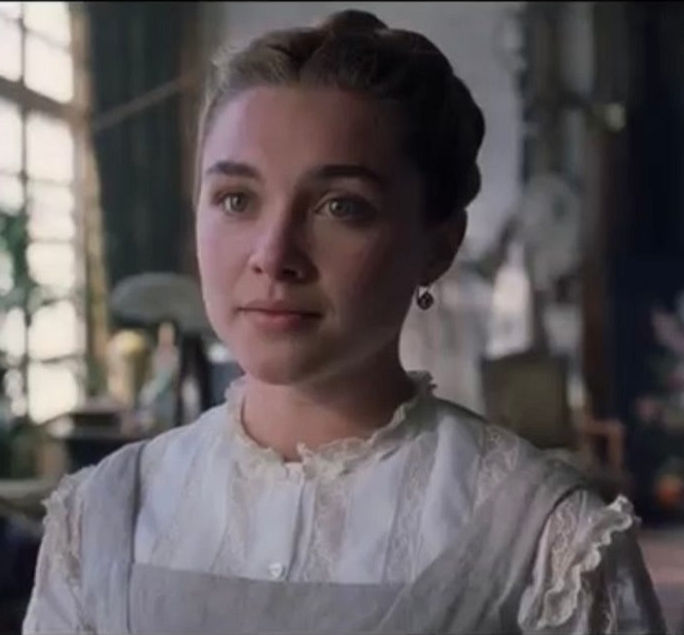
Well, I'm not a poet. I'm just a woman. And as a woman, there's no way for me to make my own money. Not enough to earn a living or support my family. And if I had my own money, which I don't, that money would belong to my husband the moment we got married. And if we had children, they would be his, not mine. They would be his property. So don't sit there and tell me that marriage isn't an economic proposition because it is. It may not be for you, but it most certainly is for me.
Jo, Laurie and Amy’s love triangle
The Laurie-Amy angle always felt forced to me. I think both the book and the movie do it much the same way but I prefer the movie here because Timothee Chalamet and Florence Pugh had palpable chemistry which the book just lost somewhere along the lines. The scene where Laurie removes Amy’s painting apron makes me catch my breath. Every. Single. Time.

Laurie and Jo’s fight when he proposes adheres to the script, again not much difference. Their entire relationship, in fact, isn't much different from that in the book, except for the fact that Jo suspects feelings on Laurie's part from beginning of Part II of the book. I think the actors and their chemistry plays a big role behind the film adaptation faring better in my eyes.

Beth’s death
I love how the book explores the themes of feeling insignificant from Beth’s eyes. I adore how Beth’s virtues make her the best of them, unlike Jo’s talents and ambitions, unlike Amy’s society and worldliness and unlike Meg’s period appropriate womanhood. Beth has a special place in my heart but the book romanticizes her death. In the book, Beth is merely returning home to God’s kingdom, the blow is softened and her death is seen as her own salvation.

But the movie delivers the shock despite its eventuality. The harsh mortality of life is a tangible and bitter truth, something even the thought of little angel-sweet Beth returning “home” could not placate. The scene where Beth tells Jo to write for her, has much more impact because of her death shortly after it. The way the same scene is played out twice, once when she is sick and the other when she is dead, pulls at your heartstrings. It is an angel’s death, yes, but it is death all the same.
Castles in the air
This I admit is the biggest factor for my preference of the movie. Call me impractical but I hated how the characters in the book seemed to “settle” for what life handed to them. Their "castles in the air" as they had once coined their dreams, ended up being just that: a castle in the air, nothing that became tangible. The difference from the book is, however, made only in Jo’s story.
In the end of the book, Jo accepts that she hasn’t seen enough of the world to write about it just yet and that good writing takes time. She has made peace with the fact that writing could be her future but is not her present. She has a family now and plans to start a school for boys. She is content. She does become a writer in the sequel, “Jo’s Boys”, but we’re talking about the first book here. Reading the apple orchard scene was a bit of a downer for me.
In the movie, Jo finally writes “Little Women”, taking into account the semi autobiographical nature of the book. She gets it published and there is this lovely sequence where she is watching the book be made and is reminded of all the times she and her sisters played make believe: all the times they ran around their little room, happy in their own little world. She is reminded of childhood. Along with tears, a sense of satisfaction wells up, because this is a character you’ve seen grow up, and fall again so many times. It gives fruition to all her toils and all her dreams.
I adore Louisa May Alcott's Little Women, it makes me experience all colours of childhood again, painfully acknowledges "growing up" and stays relevant even after all these years. But for the time being, I simply like better the instances where the movie deviated from the source material.
Do you like the book over the many film adaptations? Do let me know in the comments below!
Thank you for reading <3


Comments